Krishnavataram Movie 2026 Vegamoviees Review Details
Krishnavataram 2026 Hindi Review – Is Siddharth Gupta’s Divine Act a Career-Defining Moment?
Honestly yaar, when I first heard about Krishnavataram releasing in Hindi, I wasn’t sure if we needed another mythological epic.
But after watching the Hindi cut twice, I’m convinced this is one of the most emotionally mature takes on Lord Krishna we’ve seen in recent years.
It doesn’t just show you the god — it makes you feel the man behind the blue skin.
Star Power Hook: Siddharth Gupta’s Make-or-Break Moment
Siddharth Gupta has always been the “promising newcomer” in Bollywood, but Krishnavataram finally gives him a role that demands gravitas, vulnerability, and that rare ability to appear both divine and deeply human.
Post-Majhail and Jatt & Juliet 3 comparisons aside, this is his most challenging outing — and he owns it.
Character-Driven Plot Outline: Love, Loss, and Dharma
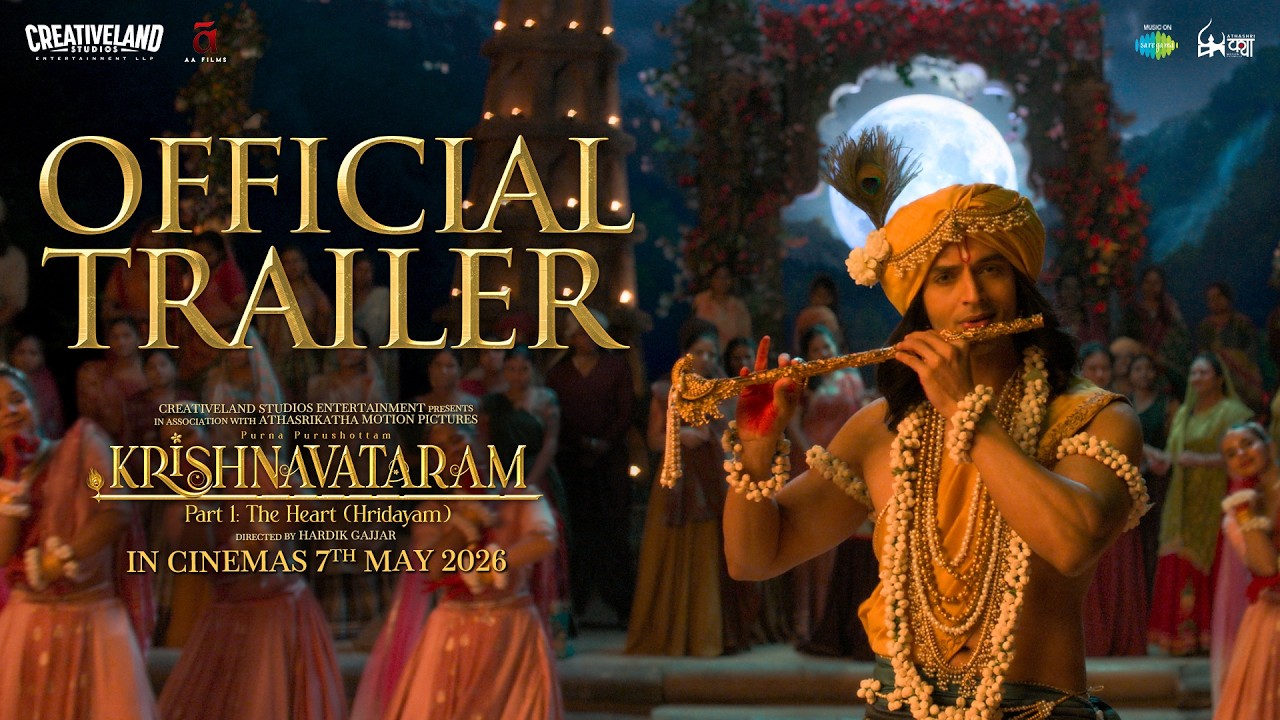
The film follows Krishna’s life after Radha’s departure, focusing on his years in Dwarka with Satyabhama, the emotional haunting of Vrindavan memories, and his reluctant march toward Kurukshetra.
It’s not a blow-by-blow Mahabharata retelling — it’s a character study of a man who must choose between personal longing and cosmic responsibility.
The Hindi version frames everything through Satyabhama’s eyes, making her the audience’s emotional gateway. We see Krishna as a husband, a king, a friend to Draupadi, and finally a charioteer who must deliver hard truths to Arjuna.

The three-act structure is clean: Dwarka’s opulence, Radha’s spiritual shadow, and Kurukshetra’s brutal clarity.
Cast & Crew Table
| Role | Name |
|---|---|
| Director | Hardik Gajjar |
| Krishna (Lead) | Siddharth Gupta |
| Satyabhama (Female Lead) | Sanskruti Jayana |
| Supporting Cast | Sushmitha Bhat, Nivaashiyni Krishnan |
| Music (Hindi) | Prasad S., Irshad Kamil (lyrics) |
| Producers | Shree Krishna Film |
Section 1: Lead Performance Breakdown – Siddharth Gupta’s Dual Act
Siddharth doesn’t just play Krishna; he inhabits him. The real challenge here is that Krishna operates on multiple registers — divine detachment, marital tenderness, political shrewdness, and cosmic grief. Gupta balances all four without letting one dominate.
Watch his eyes in the Radha flashback sequences. There’s a hollow depth there that’s rare for a younger actor. His dialogue delivery in Hindi is measured — no unnecessary shouting, no theatrical hand gestures.
When he delivers the Bhagavad Gita lines, it feels like he’s thinking them out loud, not reciting scripture. That’s a career-best act waiting to be recognized.
Section 2: Supporting Cast & Antagonist Impact
Sanskruti Jayana as Satyabhama is the film’s emotional spine. Her Hindi dubbing is crisp, and she brings a modern sensibility to a character often reduced to “jealous wife” archetype. Here, Satyabhama is intelligent, questioning, and fiercely protective of her marriage.
Sushmitha Bhat’s role as Radha’s spiritual echo is brief but scene-stealing — especially a silent sequence where she watches Krishna from across a Yamuna bank. No dialogue, just a tear rolling down. Goosebumps stuff.
Nivaashiyni Krishnan plays a Yadava court figure with quiet authority, adding gravitas to Dwarka’s palace scenes. There’s no single antagonist in the traditional sense — the real “villain” is Krishna’s own internal conflict between desire and duty.
Section 3: Chemistry Check – Romance & Rivalry Dynamics
The Krishna-Satyabhama bond feels authentic because it’s built on companionship, not just romance. They argue about politics, share silences, and there’s a lovely scene where Satyabhama combs Krishna’s hair while discussing Kurukshetra’s impending war.

That’s intimacy you don’t see often in mythological films.
The Radha-Krishna dynamic, though mostly shown in flashback, is whistle-worthy in its restraint. No over-the-top longing. Just two people who know they can’t be together, and the quiet acceptance of that truth.
Acting Scorecard Table
| Actor/Role | Rating & Comment |
|---|---|
| Siddharth Gupta / Krishna | ⭐⭐⭐⭐⭐ – Career-best, subtle divinity |
| Sanskruti Jayana / Satyabhama | ⭐⭐⭐⭐✨ – Emotional anchor, strong presence |
| Sushmitha Bhat / Radha (cameo) | ⭐⭐⭐⭐ – Silent scene masterclass |
| Nivaashiyni Krishnan / Yadava Court | ⭐⭐⭐⭐ – Solid supporting gravitas |
| Hindi Voice Cast (Ensemble) | ⭐⭐⭐⭐ – Dubbing syncs well with lip movements |
Section 4: Emotional High Points – Scenes That Stay With You
1. The Yamuna Bank Silence: After a heated argument with Satyabhama about Radha, Krishna sits alone by the river. No background score. Just ambient water sounds and Gupta’s micro-expressions. You can literally feel the weight of centuries on his shoulders.
2. Draupadi’s Vastra Haran – A Different Lens: The film shows Krishna’s intervention not as a grand miracle but through a private moment where he tells Draupadi, “I don’t save you because you’re pious.
I save you because you refused to be a victim.” That line in Hindi lands with thunderous impact.
3. The Vishvarupa Revelation: Unlike typical CGI-heavy versions, this one uses extreme close-ups of Gupta’s face morphing into multiple expressions — joy, rage, sorrow, peace — all at once. It’s unsettling and beautiful.
FAQs – Performance Centric
Q: Is Siddharth Gupta convincing as Lord Krishna in the Hindi version?
A: Absolutely. He brings a refreshing restraint to the role, avoiding the usual theatricality.
His Hindi diction is clean, and his emotional range — from playful to devastating — is on full display. This is his career-best act without question.

Q: How does Sanskruti Jayana perform as Satyabhama in Hindi?
A: She’s a revelation. Her Satyabhama is not a footnote in Krishna’s story — she’s the narrator.
Her Hindi dubbing is seamless, and she holds her own against Gupta in every scene. Definitely a scene-stealer in her own right.
Q: Does the Hindi version lose anything compared to the original Telugu/Tamil cut?
A: The Hindi dub actually benefits from stronger lyrical translations, especially in songs like “Prem Ki Leela.” The emotional beats remain intact.
Some Telugu cultural nuances are slightly diluted, but for Hindi-speaking audiences, this version feels organic, not dubbed.
Ratings are purely my take after multiple watches — your experience might differ!