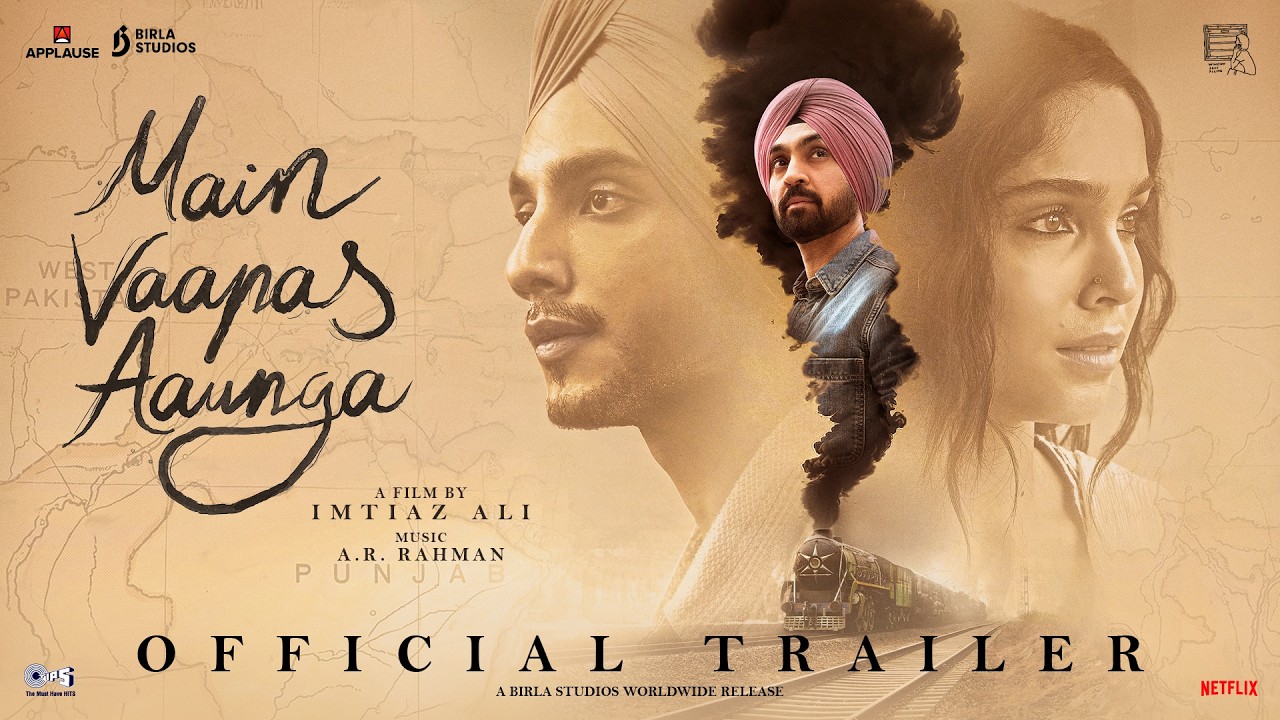
Main Vaapas Aaunga Movie 2026 Vegamoviees Review Details
Main Vaapas Aaunga 2026 Review – Diljit’s Career-Defining Act or Imtiaz’s Best Work Yet?
You know that feeling when a film stays with you long after the credits roll? That’s Main Vaapas Aaunga for me. After watching it thrice in the first week itself, I can confidently say this isn’t just another love story — it’s a masterclass in emotional storytelling, anchored by powerhouse performances and a soul-stirring A.R.
Rahman score.
Character-Driven Plot Outline
The film operates on two hauntingly beautiful timelines. In 1947 pre-Partition India, a young couple (Vedang Raina and Sharvari) fall deeply in love, only to be torn apart by the violence of Partition.
The young man makes a desperate promise — “Main vaapas aaunga” — a promise he can never keep.
Fast forward to present day. An elderly man (Naseeruddin Shah) lies on his deathbed, haunted by that very promise. His grandson (Diljit Dosanjh), a struggling filmmaker, decides to reconstruct his grandfather’s lost love story through cinema.
What unfolds is a meditation on memory, grief, and the impossible weight of words left unfulfilled.
Cast & Crew
| Role | Name |
|---|---|
| Director | Imtiaz Ali |
| Music Director | A. R. Rahman |
| Lyricist | Irshad Kamil |
| Producers | Mohit Choudhary, Sameer Nair, Deepak Segal |
| Lead Actor (Grandson) | Diljit Dosanjh |
| Lead Actor (Young Lover) | Vedang Raina |
| Lead Actress (Young Lover) | Sharvari Wagh |
| Supporting Actor (Elderly Man) | Naseeruddin Shah |
Lead Performance Breakdown
Diljit Dosanjh – The Soul of Contemporary Cinema
Diljit delivers what I believe is his most layered performance to date. He sheds his usual swagger and becomes a vessel for generational grief. His eyes do the heavy lifting — watch him in the scene where he first hears his grandfather’s story.
The way his smile fades, replaced by a dawning realization of loss, is pure magic.
His dialogue delivery has matured tremendously. The lines “Main use dhoondh launga, dada” are spoken with such childlike conviction that you forget you’re watching a superstar.
Vedang Raina – The Breakout Star of 2026
This young man is going places. As the Partition-era lover, Vedang embodies innocence and desperation simultaneously. His physical transformation is striking — gaunt, haunted, yet radiating hope.

The train station farewell scene? Pure cinema. His voice cracks saying “Main vaapas aaunga” and you feel every ounce of that promise’s weight.
Sharvari – Resilience Personified
Sharvari doesn’t just play the victim of Partition; she plays survival. Her character carries the film’s emotional backbone. The scene where she waits at the window, years passing on her face through subtle makeup and performance shifts, is a masterclass in restraint.
No melodrama, just quiet devastation.
Supporting Cast & Antagonist Impact
Naseeruddin Shah – The Haunting Anchor
At 76, Naseeruddin Shah reminds us why he’s the Mount Everest of Indian acting. His elderly man doesn’t just remember his lost love — he becomes the memory.
The monologue where he whispers “Main wapas aa gaya hoon, lekin ab use dhondh nahi pa raha” will haunt your dreams. Every wrinkle on his face tells a story of decades spent waiting.
Who Elevated the Film?
The supporting ensemble deserves special mention. The village elder who warns the young couple? A single scene of silent disapproval. The train station official who tears apart the lovers’ hands?
His cold bureaucracy is more terrifying than any villain. These characters don’t need dialogue to break your heart.
Chemistry Check
Romance That Transcends Time
Vedang and Sharvari’s chemistry is electric yet tender. Their love feels stolen, precious, doomed — exactly what a Partition romance should feel like. The scene where they share a single roti under a tree, laughing at the absurdity of their situation, is whistle-worthy in its simplicity.
Diljit and Naseeruddin’s grandfather-grandson bond is equally compelling. Watch the scene where Diljit massages Naseeruddin’s feet — no dialogue, but you feel decades of love and unspoken understanding.
Rivalry Dynamics
The real antagonist here isn’t a person — it’s history itself. The communal violence that separates the lovers is depicted with chilling restraint. Imtiaz doesn’t show gore; he shows aftermath. A burning cart, a child’s shoe left behind, a door that won’t open. Brilliant filmmaking.

Acting Scorecard
| Actor / Role | Rating / Comment |
|---|---|
| Diljit Dosanjh (Grandson) | 9/10 – Career-best emotional range |
| Vedang Raina (Young Lover) | 9/10 – Breakthrough performance, pure vulnerability |
| Sharvari Wagh (Young Woman) | 8.5/10 – Resilience personified |
| Naseeruddin Shah (Elderly Man) | 10/10 – Haunting, generational masterpiece |
Emotional High Points
The Train Station Farewell
This is the scene that will break everyone. Vedang and Sharvari are separated by a crowd, their hands reaching for each other. As the train pulls away, his scream of “Main vaapas aaunga!” echoes across the platform.
The camera holds on her face — hope, despair, and love all fighting for space. Rahman’s score swells, but never overwhelms. Perfect.
The Elderly Man’s Breakdown
Naseeruddin Shah’s scene where he finally admits “Main wapas nahi aa paya” is gut-wrenching. His voice breaks like a child’s, and suddenly this 76-year-old man becomes that 20-year-old boy who couldn’t keep his promise.
Diljit’s reaction, silently crying while holding his grandfather’s hand, is equally powerful.
The Final Reunion – Real or Imagined?
Imtiaz keeps us guessing. Is the elderly man’s final vision of his lost love real or a hallucination? Sharvari appears in a white saree, ageless, smiling. No dialogue needed. The ambiguity is the point — closure isn’t always about truth, sometimes it’s about acceptance.
Technical Brilliance
VFX That Serves the Story
The VFX in Main Vaapas Aaunga is invisible, which is the highest compliment. The Partition-era crowd scenes use subtle digital multiplication.
The time-lapse transitions showing seasons changing, the elderly man’s room aging around him — all executed with restraint. No flashy CGI, just emotional amplification.
A.R. Rahman’s Soulful Soundscape
Rahman returns to his Roja-era melodic purity. The title track “Main Wapas Aaunga” is already a chart-topper. But it’s the background score that truly elevates.
The recurring piano motif when the elderly man remembers his love — simple, repetitive, devastating. One whistle-worthy note: the song “Main Wapas Aaunga Apne Gaon Mein” uses folk instruments so authentically you’ll smell the earth.
Imtiaz Ali’s Direction
This is Imtiaz’s most mature work. He controls the melodrama, letting silence speak louder than words. The film-within-a-film concept isn’t gimmicky; it serves the narrative. The color grading — sepia for the past, warm amber for the present — visually separates timelines without confusion.

Box Office & Commercial Outlook
Pre-release estimates suggest the film needs around ₹137 crore net in India to help Diljit achieve his milestone year. Opening day projections are in the ₹3–6 crore range, but strong word-of-mouth and music are expected to drive longevity.
The film is positioned as a prestige drama rather than a mass-market entertainer, which may limit its single-screen reach but amplify its critical acclaim.
Critical Review: Pros & Cons
What Works
- Imtiaz Ali’s emotional maturity as a director
- Naseeruddin Shah’s generational performance
- Diljit Dosanjh’s career-best acting range
- A.R. Rahman’s soul-stirring soundtrack
- Restrained handling of Partition trauma
What Could Be Better
- Some may find the pacing slow in the second act
- The present-day timeline feels less developed than the past
- Imtiaz Ali’s familiar motifs may feel repetitive to hardened critics
- Limited mass-market appeal due to niche theme
Frequently Asked Questions
1. Is Diljit Dosanjh’s performance in Main Vaapas Aaunga better than his previous work?
Absolutely. This is his most emotionally demanding role. He sheds his superstar persona completely and becomes the grandson carrying generational grief. His micro-expressions, especially in the silent scenes with Naseeruddin Shah, show remarkable growth.
2. Does Vedang Raina live up to the hype after The Archies?
Yes, and then some. Vedang proves he’s not just a debut wonder. His portrayal of a man torn between love and circumstance is deeply moving. The train station farewell scene alone should earn him Best Actor nominations.
3. Is the film too melodramatic or does it earn its emotions?
Imtiaz Ali earns every tear. The film never forces emotion; it allows moments of silence, humor, and even mundane daily life to counterbalance the heavy themes. The Partition violence is shown through aftermath rather than graphic depiction, making it more impactful.
Ratings are purely my take after multiple watches — your experience might differ!