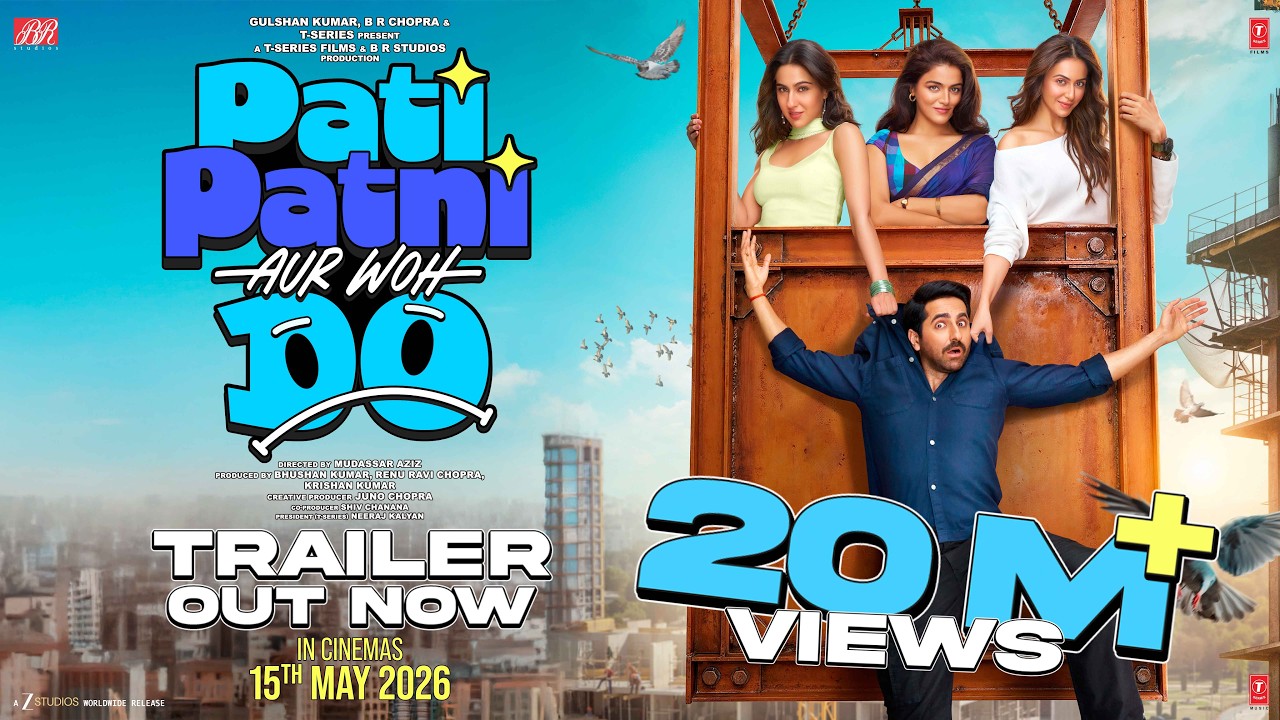
Pati Patni Aur Who Do Movie 2026 Vegamoviees Review Details
Pati Patni Aur Woh Do (2026) Review – Ayushmann Khurrana’s Comeback Comedy or Midsummer Hype?
I watched this one thrice this weekend — first solo, then with family, then just to catch the “Roop Di Rani” hook step again. And honestly? Mudassar Aziz’s latest feels like a warm plate of aloo paratha on a rainy evening — not gourmet, but satisfying when you’re craving comfort cinema.
Yeh film ka magic Ayushmann ke career-best comic timing mein chhupa hai, you know? After a phase of heavy experimental roles, he’s back to his Bareilly Ki Barfi zone — and it’s whistle-worthy.
Character-Driven Plot Outline — Love, Lies & Prayagraj
Prajapati Pandey (Ayushmann) is a forest department officer in Prayagraj with a reputation for being too honest. His wife Aparna (Wamiqa Gabbi) is a sharp journalist who values truth above everything.
When his childhood friend Chanchal (Sara Ali Khan) begs for help to elope with her boyfriend Sunny (Vishal Vashishtha), Prajapati gets caught in a web of white lies that spin into a full-blown comedy of errors.
The emotional hook? Prajapati isn’t cheating — he’s just too nice to say no. That one moment of kindness snowballs into a misunderstanding involving three women, two families, and one very confused mohaneda officer.
| Role | Name |
|---|---|
| Director | Mudassar Aziz |
| Producer | Bhushan Kumar, Anubhav Sinha |
| Music | Tanishk Bagchi |
| Cinematography | Manoj Pillai |
| Editor | Chandan Arora |
| Lead Actor | Ayushmann Khurrana |
| Lead Actress | Wamiqa Gabbi |
| Supporting Lead | Sara Ali Khan |
| Supporting Lead | Rakul Preet Singh |
| Veteran Support | Pankaj Tripathi, Neena Gupta |
Section 1: Lead Performance Breakdown — Ayushmann’s Comic Clockwork
Ayushmann does something interesting here. He plays the “confused husband” trope not as slapstick but as a man genuinely overwhelmed by his own kindness.
Watch his eyes during the scene where Aparna asks him directly: “Tumhe woh ladki pasand hai?” — he says “no” but his eyebrows say “help me.” That micro-expression work?
That’s why he’s a star.
His dialogue delivery in the “Angdayi” sequence (the folk-comedy track) is a masterclass in breath control and timing. He pauses exactly when you expect him to rush, and rushes when you expect him to pause.

But the real standout moment? The silent breakdown scene in the car after Aparna leaves the house. No dialogues, no background score — just Ayushmann’s face cracking bit by bit. That’s the scene that made my second watch worth it.
Section 2: Supporting Cast & Antagonist Impact — The Real Scene-Stealers
Here’s where the film surprises you. Pankaj Tripathi as Prajapati’s father is comedy gold in a serious wrapper. He delivers every line like he’s solving a family puzzle — the pause before saying “beta, ek baat batau?” had the entire theatre laughing.
Wamiqa Gabbi gives Aparna a grounded dignity that could have easily become shrill. She’s not the “nagging wife” — she’s a woman who smells something wrong and refuses to gaslight herself. Her confrontation scene at the 90-minute mark is career-defining material.
Sara Ali Khan as Chanchal is pure chaos energy — but in a controlled way. She brings spontaneous physical comedy that feels natural, not rehearsed. The scene where she drags Prajapati across the wedding venue? Absolute timing.
Rakul Preet Singh’s Nilofer is the wildcard. Her misinterpreted “romantic interest” arc is played with such deadpan honesty that you almost feel bad for her. Almost.
Section 3: Chemistry Check — Who Sparks & Who Fizzles?
Let’s talk real: Ayushmann and Wamiqa have the kind of married chemistry that feels lived-in. They bicker like a real couple — not “cute bickering” but that tired “I’ve heard this joke 300 times” tone. It’s authentic and rare in Bollywood rom-coms.
Ayushmann and Sara? Platonic chaos energy. They feel like that friend you have to manage — not romantic, just protective. That works for the plot because Chanchal’s arc isn’t about romance with Prajapati.
The real surprise? Rakul Preet and Wamiqa’s rivalry chemistry is electric. They barely share screen time, but when they do, you feel the tension. Would’ve loved a proper face-off scene between the two.
Table 2: Acting Scorecard
| Actor / Role | Rating / Comment |
|---|---|
| Ayushmann — Prajapati | 9/10 — Career-best comic timing, micro-expressions are gold |
| Wamiqa — Aparna | 8.5/10 — Grounded, dignified, avoids shrill trap |
| Sara — Chanchal | 8/10 — Controlled chaos energy, great physical comedy |
| Rakul — Nilofer | 7.5/10 — Deadpan honesty, underused but memorable |
| Pankaj Tripathi — Father | 9/10 — Every pause is a punchline |
| Neena Gupta — Mother | 8/10 — Earthy warmth, comic relief without trying |
| Tisca Chopra — “Woh #3” | 7/10 — More a plot device than character |
| Vishal Vashishtha — Sunny | 6/10 — Functional, no standout moments |
Section 4: Emotional High Points — Scenes That Stay With You
Three scenes gave me chills. First: the “kaagaz ki naiya” metaphor sequence. Prajapati tears up a paper boat while explaining how his life is floating. Ayushmann’s voice cracks on “main toh bas bach raha hoon.” Whistle-worthy acting.

Second: Aparna’s breakdown in the kitchen. Wamiqa doesn’t cry loudly — she just stops, stares at the stove, and lets one tear fall. That’s the kind of restraint that makes a performance unforgettable.
Third: the climax reconciliation scene without dialogues. The two leads just sit on a bench, not looking at each other, but their shoulders relax together. No cliché dialogue, no big speech — just two people deciding to trust again.
The film uses silence more effectively than most big-budget action films use explosions. That’s where its heart lives — in the quiet moments between the lies.
Technical Specs: VFX, Sound & Cinematography
Let’s not pretend this is a visual spectacle. But Manoj Pillai’s cinematography captures Prayagraj’s raw texture — the dust, the narrow lanes, the evening light on the ghats. It feels like a place, not a set.
Sound design is surprisingly smart. The background music during the “misunderstanding” sequences uses faintly discordant flute notes that unsettle you without announcing “this is funny.” Subtle, effective.
VFX is minimal — some crowd replication in wedding scenes and light grading for the song sequences. Clean work, no green-screen shininess.
3 FAQs — Performance-Centric Questions
Is Ayushmann Khurrana’s performance better than his previous comedies?
I’d say it’s his most controlled comic performance. While Bareilly Ki Barfi relied on his wide-eyed innocence and Dream Girl on his voice modulation, here he uses facial micro-expressions and breath control to sell the comedy.
It’s less flashy but more mature.
Does Wamiqa Gabbi get enough screen time to shine?
Not enough, honestly. Her arc is the emotional backbone but she gets about 30% less screen time than the male lead. However, every minute she’s on screen is impactful — her performance is so efficient that you remember her scenes more than their duration suggests.

Who gives the surprise best performance?
Pankaj Tripathi and Rakul Preet Singh tie for me. Tripathi because he turns a potentially repetitive “wise father” role into something fresh with his timing; Rakul because her deadpan interpretation of the “other woman” trope avoids all clichés.
She’s not jealous or vindictive — just genuinely confused. That’s hard to pull off.
—
Box Office, Songs & Overall Verdict
The film opened at ₹4 crore net on Day 1 and grew 50-60% on Day 2 to ₹5.75 crore, suggesting strong family word-of-mouth. Worldwide gross touched ₹15 crore in two days, healthy for a mid-budget comedy in 2026’s action-heavy calendar.
Music by Tanishk Bagchi is a mixed bag — “Roop Di Rani” and “Dheeme Dheeme 2.0” are earworms that won’t leave your head, but the soundtrack relies heavily on nostalgia and revival. Grade: 7/10.
Overall: 7.2/10 — A warm, family-friendly comedy that works because of its performances, not its plot. Ayushmann proves he’s still the king of mid-budget character-driven hits. Take your parents, switch off your phone, and enjoy the comfort food of Bollywood.
Ratings are purely my take after multiple watches — your experience might differ!